Showing posts with label Province-style Cooking. Show all posts

Thursday, December 13, 2007

"Pangat Na Salinyasi Sa Sampalok"


Ingredients:
  • 100 grams tamarind fruit (sampalok)
  • 2 medium red ripe tomatoes
  • 1 medium native onion
  • 2 cups rice wash
  • 2 tsps iodized coarse salt
  • 400 grams (salinyasi), gutted
  • 2 pcs finger chilis

Procedure:

In a claypot or earthpot, put the first-four ingredients. Cover. Bring to boil over medium-high heat. Then lower heat to medium-low. Bubble away for 6 minutes.

Increase the fire again to medium-high, sprinkle salt. Then, mash carefully the tamarind fruit and tomatoes. Put the fish accordingly. Add the chilis. Swirl the pan carefully. Lid on again. Bring to boil. Simmer in low fire for 2-3 minutes.

Serve immediately. Best with warm cooked rice and fish sauce with mashed chili, for your dip.

Monday, December 03, 2007

"Pinakbet" (Low-Land Vegetables Stir-fry)


Ingredients:

  • 2 tbsps oil
  • 1 slab (200-250 grams) pork belly, cubed
  • 1/2 tsp iodized coarse salt
  • 1/4 tsp ground black pepper
  • 4 cloves garlic, finely pounded
  • 2 medium (70 grams) red onion, halved & thinly sliced
  • 2 large (100 grams) red plump tomatoes, halved & thinly sliced
  • 2 tbsps fish sauce
  • 3 tbsps Ginataang Alamang (recipe here)
  • 2 slices (750 grams) squash, cut into 2" cubed with the skin on
  • 12 pcs string beans (sitaw)
  • 1o small pcs okra
  • 1-3/4 cup rice wash or water
  • 1/2 tbsp white sugar
  • 2 small pcs (180 grams) eggplant (talong), quartered & cut into 2" length

Procedure:

In a large wok, put the oil, pork, salt and pepper. Stir-fry until pork turns light brown in color. Be careful the oil will definitely splatter while you do this step. When done, remove from pan the pork. Retain the oil. Add the garlic. Saute until golden brown. Follow with onion and tomatoes. Saute until limp. Pour in the fish sauce. Cook until it dries up.

Put the ginataang alamang, squash, string beans and okra. Mix. Cover. Cook for 3 minutes.

Add rice wash. Mix well. Cover again. Cook for 5 minutes.

Lastly, sprinkle the sugar. Put the eggplant. Mix again. Lid on. Cook for another 5 minutes.

Serve with fried fish and freshly cooked rice.

Tuesday, November 20, 2007

"Pangat na Malacapas sa Kalamansi" (Majorra Poached in Philippine Lemon, Ginger & Chili)

Ingredients:
  • 60 grams ginger
  • 2 pcs finger chilis
  • 600 grams majorra (malacapas), gutted
  • 2 tsps iodized coarse salt
  • 12 pcs (160 grams) Philippine Lemon (kalamansi)
  • 3 cups rice wash


Procedure:

Pound the ginger. Place half of it at the bottom of the claypot. Put a piece of finger chili. Put the fish accordingly. Sprinkle with salt evenly. Squeeze the kalamansi over the fish. Put the kalamansi skin and seeds in a bowl. Add the rice wash in it. Mash. Pour and strain over the fish. Put the last piece of finger chili and the rest of the ginger.

Swirl the pot gently to mix all the ingredients. Cover. Place over medium-high fire. Bring to boil. Cook for a minute.

Serve immediately, with rice and fish sauce for your dip.

Wednesday, November 14, 2007

"Sinigang na Bangus sa Tunay na Sampalok" (Milkfish in Real Tamarind Broth)

Ingredients:
  • 5 cups rice wash
  • 150 grams tamarind fruit (sampalok)
  • 1 large red onion
  • 3 large red plump tomatoes
  • 2-3 pcs small pcs native taro (gabing tagalog)
  • 5 pcs okra, remove both ends
  • 5 pcs string beans (sitaw), cut at 2" length
  • 1 small radish (labanos), sliced diagonally
  • 2 tsps iodized coarse salt
  • 1/2 kg milkfish, scaled, gutted & cut into 5 pcs diagonally
  • 1 small eggplant (talong), sliced at 1/8" thick
  • 2-3 pcs finger chilis
  • half-bunch of swamp cabbage (kangkong), leaves & tender stalks only


Procedure:

In a claypot or earthpot (palayok), put the first-five ingredients. Cover. Over medium heat. Bring to boil. Bubble away for 12-15 minutes. Mash carefully the tomatoes and tamarind fruit.

Add accordingly the okra, string beans, radish, salt and milkfish. Swirl the pot. Cover. Cook for 5 minutes.

Put the chilis and eggplant. Cook for a minute. Follow with swamp cabbage. Cook until done.

Serve hot.

Monday, November 12, 2007

"Pangat na Salay-salay sa Sampalok" (Smooth-tailed Trevally Poached in Tamarind Fruit)

Smooth-tailed Trevally is a member of the fish family Carangidae. Selaroides leptolepis is the scientific name. The color of its body is a metallic bluish-silver, has a broad yellow stripe that runs from the upper margin of the eye to the caudal peduncle. It can grow up to 20 cm long.

It is known to occur throughout the waters of the Indo-western Pacific region, the Persian Gulf , the Arafura Sea, Japan and Philippines, also included the north part of Australia.

It can be found in inshore shallow estuaries and bays, as well as, on deep-water reefs to depths of 50 meters. It can also tolerate freshwater and brackish estuaries. It is usually seen in large schools.


Good for 4 servings.


Ingredients:

  • 3 cups rice wash
  • 150-180 grams tamarind fruit (sampalok)
  • 1 large plump tomato, quartered
  • 1 medium red onion, quartered
  • 1/2 kilo of smooth-tailed trevally (salay-salay)
  • 2 pcs finger chilis
  • 2 tsps iodized coarse salt

Procedure:

In a claypot or earthpot, put the 2/3 of rice wash, tamarind fruit, tomato and onion. Cover. Place over medium-high fire. Bring to boil. Lower heat to medium and bubble away for 15 minutes.

Increase fire to medium-heat, gently put the fish one by one, arrange it properly. Add the chilis and salt. Put the rest of the rice wash. Swirl and shake the pot carefully to blend fully all the ingredients. Put the lid on. Bring to boil. Then, let it boil for a minute.

Serve hot and with warm cooked rice and fish sauce, for your dip.

Sunday, October 28, 2007

"Pangat na Sapsap sa Kalamansi" (Ponyfish Poached in Philippine Lemon, Chili and Ginger)

Good for 3 servings.

Ingredients:

  • a large (50 grams) chunk of ginger, bruised lightly
  • 7 large pcs (100 grams) Philippine lemon (kalamansi)
  • 1/2 kg ponyfish (sapsap)
  • 1/2 tbsp iodized coarse salt
  • 2 pcs finger chili
  • 1-2/3 cup of rice wash or water


Procedure:

Clean the fish, carefully removing the gills and internal organs. Drain.

In a casserole, put half of the ginger at the bottom. Place the fish accordingly. Squeeze the kalamansi over the fish, straining the seeds.

Put the seeds and kalamansi skin & pulp in a bowl. Pour rice wash. Using your hand, mash several times.

Pour the liquid over the fish, run through a strainer. Sprinkle salt. Add the chili and the rest of the ginger. Cover.

Place over medium-high fire. Bring to boil. Bubble away for a minute.

Serve with rice and any vegetable dish with coconut cream.

Monday, October 22, 2007

"Sinigang na Tilapa" (St. Peter's Fish in Tamarind Soup)

Good for 4-6 servings.


Ingredients:
  • 6 cups of rice wash
  • 130 grams tamarind fruit (sampalok)
  • 1 large (70 grams) red onion, quartered
  • 2 pcs (100 grams) over ripe red tomatoes
  • a tbsp of iodized coarse salt
  • 3 medium (800 grams) St. Peter's fish (tilapia), gutted & scaled
  • 1 pc (100 grams) radish (labanos), cut into 6 parts diagonally
  • 6 pcs string beans (sitaw), cut at 2" length
  • 1 pc (100 grams) eggplant (talong), cut into 6 parts diagonally
  • 2 pcs finger chilis
  • half bunch of swamp cabbage (kangkong), leaves & tender stalks only


Procedure:

In a casserole, over medium-high heat, put the first-four ingredients. Cover. Bring to boil. Decrease fire to low. Simmer for 10 minutes.

Increase to medium heat. Mash the tomatoes and tamarind fruit carefully. Add the salt, fish, radish and string beans. Cover again. Cook for 4 minutes.

Place the eggplant and chilis. Put back the cover. Cook for 2 minutes. Add the swamp cabbage. Cook until done.

Serve with rice.

Thursday, December 14, 2006

"Paksiw na Bangus at Talong" (Milkfish and Eggplant Poached in Vinegar and Spices)


Milkfish is an important food fish in Southeast Asia. It is the sole living species in the family Chanidae, about seven extinct species in five additional genera have been reported. Scientific name is Chanos chanos. It has a generally symmetrical and streamlined appearance with a sizable forked caudal fin. They can grow to 1.7 m but are most often about 1 meter in length. They have no teeth and generally feed on algae and invertebrates.

They occur in the Indian Ocean and across the Pacific Ocean, tending to school around coasts and islands with reefs. The youngest larvae live at sea for 2–3 weeks, then migrate to mangrove swamps, estuaries and sometimes lakes returning to sea to mature sexually and reproduce. The larvae are collected from rivers and raised in ponds where they can be fed almost anything and grow very quickly, then are sold either fresh, frozen, canned, or smoked.

Milkfish is also a national symbol of the Philippines, where it is called "Bangus". Because milkfish is notorious for being much more bony compared to other food fish in the country, deboned milkfish or "boneless bangus" has become popular and common in stores and markets. The province Pangasinan, particularly in the town of Bonuan is the main source where one can buy the most delicious species of milkfish.


Good for 3 servings


You'll need:
  • a large chunk of ginger, pounded finely
  • 3 cloves of garlic, bruised lightly
  • 1 pc finger chili
  • 3 slices, about 350 grams of milkfish
  • 1 small eggplant, quartered then cut at 2" length
  • 1 tsp of whole peppercorns
  • 1-1/2 tsp of rock salt
  • 1/3 cup native white vinegar
  • 2/3 cup water


Here's how:
Place at the bottom of a porcelain or stainless casserole 2/3 of the ginger, garlic and chili. Add the milkfish, eggplant, whole peppercorns, salt and the rest of the ginger.

Pour the vinegar and water. Do not mix. Cover. Place over medium fire, bring to boil. Swirl the casserole a little to mix the ingredients.

Reduce fire to low, then, simmer for 8 minutes.

I like this dish with garlic fried rice and fish sauce (patis) with crushed chili for your dip

Tuesday, September 19, 2006

"Tochong Bangus" (Milkfish in Salted Tofu and Spices)


Philippine cuisine has its own fermented tofu called “tahuri or tahure” , a salty pickled tofu made by packing cakes of firm molded tofu with salt. No alcohol or brine is used in the process. Matured for several days or months, it becomes a brownish-yellow and acquires a uniquely complex salty flavor.


Ingredients:
  • 1 medium (500 g) milkfish (bangus), scaled & gutted, cut into 6 diagonal pieces
  • salt
  • ¼ cup cooking oil
  • ½ head of garlic, finely crushed
  • 50 grams ginger, julienne
  • 3 large (150 g) red onion, sliced thinly (sauté cut)
  • 4 large (200 g) ripe red tomatoes, sliced thinly (sauté cut)
  • 1 pc salted tofu (tahure)
  • 1 salted egg
  • 3-4 tbsps of white native vinegar (depends on how sour you want your dish to be)
  • 2 cups rice wash or water
  • 1 large (175 g) eggplant, cut at 3” length & quartered
  • 2 pcs finger chilis
  • 1 tbsp soy sauce

Here’s how:
  1. In a bowl, sprinkle the milkfish moderately with salt. Stand for 10-15 minutes. Meanwhile, cut and prepare all the vegetables. In a small bowl, mash together salted tofu and salted egg. Set aside.

  2. In a non-stick wok, over medium-high heat. Put oil, heat thoroughly. Fry lightly the milkfish on both sides. Set aside.

  3. Back to the wok, using the same oil. Put together garlic and ginger. Saute ‘til garlic is rich golden brown. Add onion and tomatoes. Cook until limp. Mash well. Put salted tofu & salted egg mixture. Cook for a minute or two. Keep stirring.

  4. Pour the vinegar. Do not stir. Bring to boil. keep boiling for 2minutes or ‘til fragrant.

  5. Add rice wash, fried fish, eggplant, chilis and soy sauce. Cover. Bring to boil. Reduce heat to medium. Simmer for 3-5 minutes or ‘til eggplant is done.

  6. Serve with warm cooked rice.

Wednesday, September 06, 2006

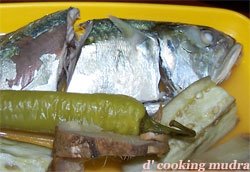
"Paksiw na Hasa-hasa" (Short-bodied Mackerel Poached in Vinegar & Spices)

Mackerel is a common name applied to a number of different species of fish. It is from the family of Scombridae, Carangidae, Hexagrammidae and Gempylidae. They live in all tropical and temperate seas. Common features of mackerels are a slim, cylindrical shape (as opposed to the tunas which are deeper bodied) and numerous finlets on the dorsal and ventral sides behind the dorsal and anal fins. If there are, the scales are very small.

They are prized and are highly harvested for their meat which is often very oily. Also, they are known for their fighting ability and for recreational and commercial fishery. The meat can spoil quickly, especially in the tropics causing scombroid food poisoning. It must be eaten on the day of capture unless cured. For this reason, mackerel is the only common salt-cured sushi.


Ingredients:
  • 50 grams of sliced ginger
  • 4 pcs, about 350 grams short-bodied mackerel (hasa-hasa), cut into two
  • 1 small (100 g) eggplant, quartered & cut at 2” length
  • 1 pc finger chili
  • 1 tsp rock salt
  • ¼ cup native white vinegar (sukang paombong)
  • ½ cup water
  • 1 tsp of vegetable or cooking oil

Here’s how:

Scrub ginger under running water until all dirt is gone. Slice. Place half of ginger at the bottom of casserole. Place fish. Add the rest of the ingredients. Cover. Place over medium-high heat. Bring to boil. Without removing the cover, swirl the casserole a few times. Reduce heat to medium-low. Simmer for 3-5 minutes.

Note:
Remember always to let your vinegar reach its boiling point before opening the cover or stirring. Uncooked vinegar leaves a ”raw” acidic taste (hilaw na suka) to your dish.